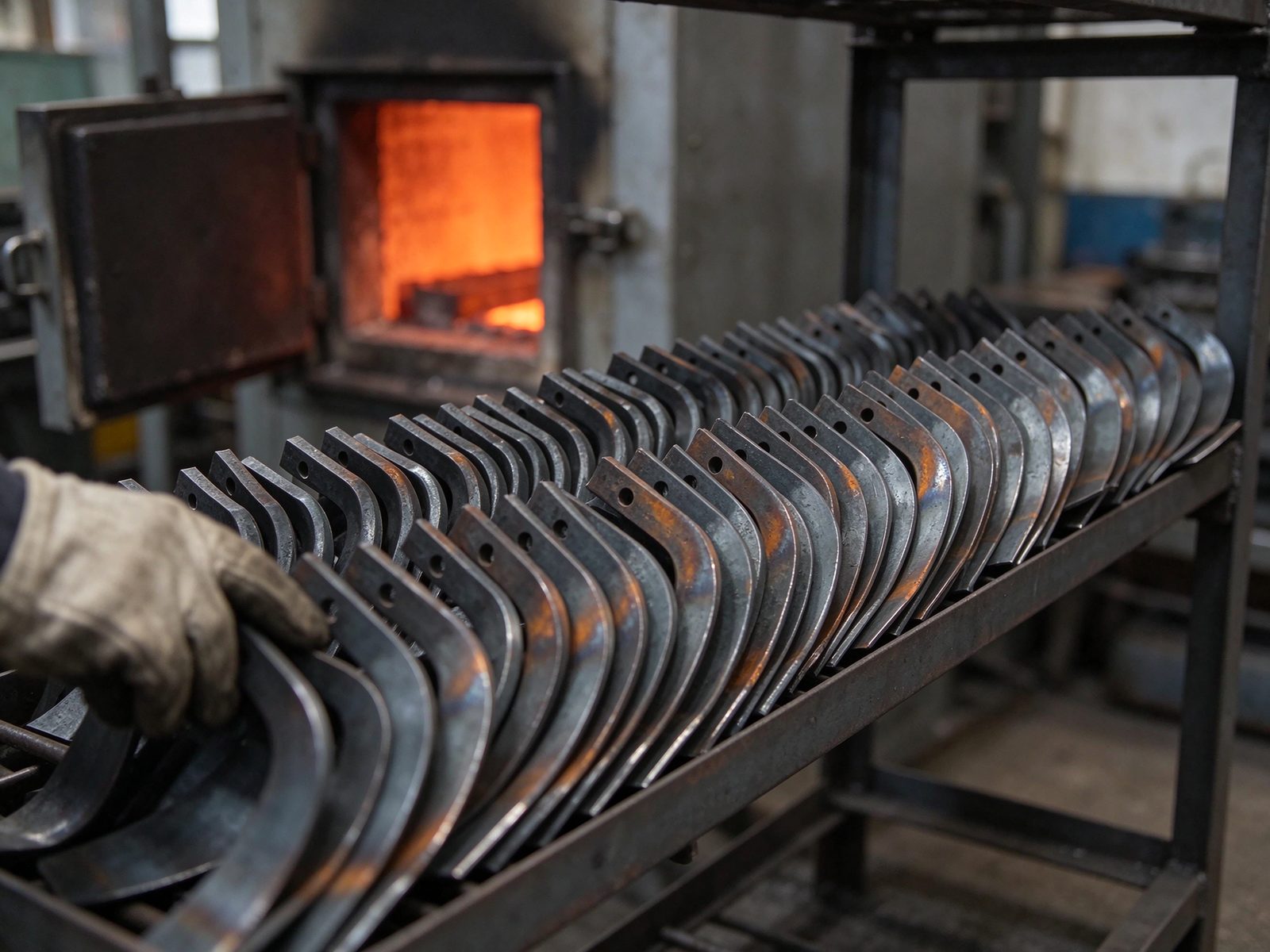
Seven steps, and the numbers we hold at each one.
A blade fails for three reasons: the grain runs across the curve, the hardness is uneven, or the hole is off-centre. Each of those is a process step, not an accident.
Billet cutting
65Mn or 28MnB5 flat bar cut to length. Heat number recorded against the order.
Heating
Induction to 1,150–1,200 °C. Overheating burns the grain boundary, so temperature is logged per batch.
Closed-die forging
The curve is formed in one blow so the grain flows along the blade instead of being cut across it. This is where strength comes from.
Trimming & punching
Flash trimmed, mounting hole punched and reamed to ±0.2 mm on diameter.
Quench
Oil or water quench depending on grade, to bring the structure to martensite.
Temper
Draws hardness back to the target range. Shank held softer than the cutting edge so it bends instead of snapping.
Straighten, grind, inspect
Cold straightening, edge grinding, hardness check at three points, then a dimensional check against the drawing.
Pack
Counted into cartons with a left/right split marked on the label, then strapped and palletised.
Documents
Mill certificate, hardness report and packing list issued with the shipping documents.
Tolerances we quote against
The parts cluster was here before we were.
Weifang sits in the middle of China’s tractor and implement belt. Forging shops, heat treatment lines, punch and die makers and a port at Qingdao are within a few hours. That is why a size change can be quoted in a day rather than a month.
What it does not give us: an automatic certificate. Every buyer who needs CE, SONCAP or SASO still pays for the inspection. We say so up front instead of promising paperwork we cannot issue.